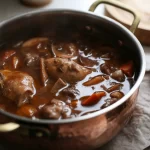
I make Hasenpfeffer when I want a rich, old-world rabbit stew with deep spice, tangy wine, and a gravy that steals the show. One spoonful explains why this German classic has lasted for generations.

I’m obsessed with Hasenpfeffer because it tastes bold, old-school, and a little wild in the best way. I love how rabbit turns rich and meaty without getting heavy, especially when red wine brings that sharp, dark edge I crave.
This stew has attitude: tangy, savory, peppery, and just rustic enough to feel like something I stumbled into at a tiny German tavern after a long day. And the sauce.
The sauce is the whole reason I keep going back. Deep, glossy, slightly sour, totally addictive.
But not fussy. Just serious flavor in a bowl, and I’m all in every time.
Ingredients

- Rabbit is lean, meaty, and soaks up that tangy sauce beautifully.
- Flour helps the pieces brown and gives the stew a cozy thickness.
- Salt and pepper keep everything sharp, not flat or muddy.
- Lard or oil gets the browning started and adds old-school richness.
- Bacon brings smoke, salt, and those little bites everyone hunts for.
- Onions melt down sweet and make the whole pot smell amazing.
- Garlic adds warmth without taking over the rabbit’s mild flavor.
- Carrots add a little sweetness, color, and honestly, some comfort.
- Red wine gives the stew depth, tang, and a proper German mood.
- Stock makes the sauce savory, rounded, and way more satisfying.
- Vinegar cuts the richness, so it’s hearty but not heavy.
- Basically, sugar softens the sharp edges and balances the vinegar.
- Juniper, cloves, bay, and thyme make it woodsy, warm, and classic.
- Plus, butter and parsley finish it glossy, fresh, and dinner-party pretty.
Ingredient Quantities
- 2.5 to 3 pounds rabbit, jointed into serving pieces
- 1/2 cup all purpose flour for dredging
- Salt and freshly ground black pepper, to taste
- 2 tablespoons vegetable oil or lard
- 4 ounces bacon or salt pork, diced
- 2 large onions, thinly sliced
- 3 garlic cloves, crushed
- 2 medium carrots, sliced (optional)
- 1 1/2 cups dry red wine
- 2 cups beef or veal stock
- 1/4 cup red wine vinegar
- 1 tablespoon brown sugar
- 1 tablespoon Dijon mustard
- 6 juniper berries, lightly crushed
- 1 teaspoon whole black peppercorns
- 3 whole cloves
- 2 bay leaves
- 2 sprigs fresh thyme or 1 teaspoon dried thyme
- 1 tablespoon butter (optional, for finishing)
- 2 tablespoons chopped fresh parsley, for garnish
How to Make this
1. Pat rabbit pieces dry, season with salt and black pepper, then lightly dredge in the flour, shaking off excess.
2. Heat the vegetable oil or lard in a large heavy pot over medium high heat and brown the rabbit in batches until well colored on all sides; transfer browned pieces to a plate.
3. Add the diced bacon or salt pork to the pot and cook until the fat renders and the pieces are lightly crisp. Remove most of the fat if excessive, leaving about 1 tablespoon.
4. Add the sliced onions and cook over medium heat until soft and beginning to caramelize, then add the crushed garlic and optional sliced carrots and cook 2 minutes more.
5. Return the rabbit to the pot, pour in the dry red wine to deglaze, scraping up any browned bits from the bottom, and simmer 2 to 3 minutes.
6. Add the beef or veal stock, red wine vinegar, brown sugar, Dijon mustard, juniper berries, whole black peppercorns, whole cloves, bay leaves, and thyme; stir to combine.
7. Bring to a gentle simmer, cover partially, reduce heat to low, and cook until rabbit is very tender, about 1 1/2 to 2 hours.
8. Remove the bay leaves, thyme sprigs, and whole cloves and peppercorns if desired; taste and adjust salt, pepper, vinegar or sugar for balance.
9. Optionally whisk in the butter to enrich the sauce, garnish with chopped fresh parsley, and serve the Hasenpfeffer hot with bread, potatoes, or spaetzle.
Equipment Needed
1. Large heavy pot or Dutch oven
2. Chef knife and cutting board
3. Plate or shallow tray for dredged rabbit
4. Measuring cups and spoons
5. Tongs or long-handled spatula
6. Wooden spoon or heatproof spatula
7. Fine-mesh sieve or slotted spoon (to remove whole spices)
8. Small whisk or spoon for finishing with butter
FAQ
German Rabbit Stew Hasenpfeffer Recipe Substitutions and Variations
- Rabbit (2.5 to 3 pounds) → Bone-in chicken thighs or legs, same weight; similar texture and braising time, milder flavor.
- Bacon or salt pork (4 ounces) → Pancetta or smoked ham, same amount; restores fat and smoky, salty notes.
- Juniper berries (6) → 1/2 teaspoon ground allspice plus a pinch of extra black pepper; gives warm, resinous, slightly piney flavor when juniper is unavailable.
- Red wine vinegar (1/4 cup) → Sherry vinegar or apple cider vinegar, equal measure; both provide bright acidity with slightly different fruit notes.
Pro Tips
1) Briefly soak or brine the rabbit in a salted milk or buttermilk mix for 2 to 4 hours before cooking. It mellows gamey flavors and keeps the meat tender and moist without masking the rabbit character.
2) Get a deep, even brown on the dredged pieces in batches. Doneness of the sauce depends on those brown fond bits, so don t crowd the pot and let each piece develop color before returning them to the braise.
3) Toast and lightly crush the juniper berries and whole peppercorns in a dry pan first. That wakes up their oils and makes the braise aroma brighter; add the cloves whole so you can fish them out later without leaving bitter shards.
4) Skim and reduce the braising liquid if it seems thin after cooking, then strain and return to the pot to finish. Whisk in the butter off the heat for gloss and to round flavors, or stir in a spoonful of mustard for a slightly sharper lift if needed.
5) Let the finished stew rest for 20 to 30 minutes off the heat before serving. The flavors meld and the sauce thickens slightly, and you ll find it tastes better the next day if you re making it ahead.

German Rabbit Stew Hasenpfeffer Recipe
I make Hasenpfeffer when I want a rich, old-world rabbit stew with deep spice, tangy wine, and a gravy that steals the show. One spoonful explains why this German classic has lasted for generations.
6
servings
350
kcal
Equipment: 1. Large heavy pot or Dutch oven
2. Chef knife and cutting board
3. Plate or shallow tray for dredged rabbit
4. Measuring cups and spoons
5. Tongs or long-handled spatula
6. Wooden spoon or heatproof spatula
7. Fine-mesh sieve or slotted spoon (to remove whole spices)
8. Small whisk or spoon for finishing with butter
Ingredients
-
2.5 to 3 pounds rabbit, jointed into serving pieces
-
1/2 cup all purpose flour for dredging
-
Salt and freshly ground black pepper, to taste
-
2 tablespoons vegetable oil or lard
-
4 ounces bacon or salt pork, diced
-
2 large onions, thinly sliced
-
3 garlic cloves, crushed
-
2 medium carrots, sliced (optional)
-
1 1/2 cups dry red wine
-
2 cups beef or veal stock
-
1/4 cup red wine vinegar
-
1 tablespoon brown sugar
-
1 tablespoon Dijon mustard
-
6 juniper berries, lightly crushed
-
1 teaspoon whole black peppercorns
-
3 whole cloves
-
2 bay leaves
-
2 sprigs fresh thyme or 1 teaspoon dried thyme
-
1 tablespoon butter (optional, for finishing)
-
2 tablespoons chopped fresh parsley, for garnish
Directions
- Pat rabbit pieces dry, season with salt and black pepper, then lightly dredge in the flour, shaking off excess.
- Heat the vegetable oil or lard in a large heavy pot over medium high heat and brown the rabbit in batches until well colored on all sides; transfer browned pieces to a plate.
- Add the diced bacon or salt pork to the pot and cook until the fat renders and the pieces are lightly crisp. Remove most of the fat if excessive, leaving about 1 tablespoon.
- Add the sliced onions and cook over medium heat until soft and beginning to caramelize, then add the crushed garlic and optional sliced carrots and cook 2 minutes more.
- Return the rabbit to the pot, pour in the dry red wine to deglaze, scraping up any browned bits from the bottom, and simmer 2 to 3 minutes.
- Add the beef or veal stock, red wine vinegar, brown sugar, Dijon mustard, juniper berries, whole black peppercorns, whole cloves, bay leaves, and thyme; stir to combine.
- Bring to a gentle simmer, cover partially, reduce heat to low, and cook until rabbit is very tender, about 1 1/2 to 2 hours.
- Remove the bay leaves, thyme sprigs, and whole cloves and peppercorns if desired; taste and adjust salt, pepper, vinegar or sugar for balance.
- Optionally whisk in the butter to enrich the sauce, garnish with chopped fresh parsley, and serve the Hasenpfeffer hot with bread, potatoes, or spaetzle.
Notes
- Below you’ll find my best estimate of this recipe’s nutrition facts. Treat the numbers as a guide rather than a rule—great food should nourish both body and spirit. Figures are approximate, and the website owner assumes no liability for any inaccuracies in this recipe.
Nutrition Facts
- Serving Size: 200g
- Total number of serves: 6
- Calories: 350kcal
- Fat: 18g
- Saturated Fat: 5g
- Trans Fat: 0.3g
- Polyunsaturated: 3g
- Monounsaturated: 8g
- Cholesterol: 120mg
- Sodium: 650mg
- Potassium: 550mg
- Carbohydrates: 12g
- Fiber: 2.5g
- Sugar: 6g
- Protein: 38g
- Vitamin A: 1500IU
- Vitamin C: 8mg
- Calcium: 60mg
- Iron: 3.5mg