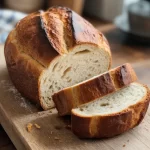
I never thought a beginner baguette could come out this crisp, golden, and bakery-worthy. This sourdough version has the crackly crust and soft, fluffy center I always hoped for.

I’m obsessed with this easy sourdough baguette because it gives me that crackly, shattering crust without making my whole day revolve around bread. The inside stays soft, fluffy, and a little chewy, which is exactly what I want when I’m tearing off a piece straight from the cutting board.
I love how bread flour and active sourdough starter turn into something that tastes bakery-level but still feels totally doable at home. And the flavor?
Tangy, simple, ridiculously good. But the crust is what gets me every time.
Loud, crisp, messy. The kind of bread I keep “testing” until half is gone.
Ingredients

- Bread flour gives the baguette chew, structure, and that bakery-style bite.
- Room-temperature water keeps the dough relaxed, stretchy, and easier to handle.
- Active sourdough starter brings tang, lift, and that cozy homemade flavor.
- Fine sea salt wakes everything up so the bread doesn’t taste flat.
- Extra flour keeps sticky dough from turning your counter into a mess.
- Semolina or cornmeal adds a little crunch underneath, which I honestly love.
- Steam helps the crust get shiny, crackly, and seriously satisfying.
- Basically, these simple ingredients make bread that feels fancy but doable.
- Plus, sourdough can be easier on your stomach than regular bread.
Ingredient Quantities
- 500 g bread flour
- 350 g water, room temperature
- 100 g active sourdough starter (100 percent hydration, recently fed)
- 10 g fine sea salt
- Extra flour for dusting, about 2 to 3 tablespoons
- Semolina or cornmeal for dusting the baking surface, about 1 tablespoon (optional)
- Water for creating steam in the oven, a small cup (optional)
How to Make this
1. In a large bowl mix 500 g bread flour and 350 g water until no dry flour remains; cover and rest 30 to 45 minutes for autolyse.
2. Add 100 g active sourdough starter and 10 g fine sea salt to the dough and mix until well incorporated.
3. Perform four sets of stretch and folds every 30 minutes during the first two hours of bulk fermentation, keeping the dough in the bowl covered between sets.
4. Let the dough continue bulk ferment at room temperature until it has increased about 30 to 50 percent in volume and feels aerated, about 2 to 4 hours depending on starter strength and room temperature.
5. Lightly flour your work surface with 2 to 3 tablespoons extra flour, turn the dough out gently and divide into three equal pieces.
6. Preshape each piece into a loose cylinder, rest uncovered 15 to 20 minutes, then shape each into a baguette about 35 to 40 cm long by flattening into a rectangle and folding lengthwise while creating surface tension.
7. Place shaped baguettes seam side down on a couche or on a parchment lined baking tray dusted with semolina or cornmeal if using, cover and proof until slightly puffy and jiggly but not overproof, about 45 to 90 minutes.
8. Preheat oven to 250 degrees Celsius with a baking stone or heavy tray inside; place a small heatproof cup for water on a lower rack if you plan to create steam.
9. Score each baguette with three to four quick slashes, transfer to the hot stone or tray, pour the small cup of water into the heatproof cup or splash onto the hot tray to create steam, and bake 20 to 30 minutes until deep golden brown and crisp.
10. Cool on a wire rack at least 30 minutes before slicing so the crumb sets.
Equipment Needed
1. Digital kitchen scale
2. Large mixing bowl with cover or plastic wrap
3. Dough whisk or sturdy wooden spoon
4. Bench scraper
5. Preshape and shaping surface (lightly floured counter or large board)
6. Linen couche or parchment paper and a small spoon of semolina or cornmeal for dusting
7. Baking stone or heavy baking tray and an ovenproof cup for water to create steam
8. Lame, sharp serrated knife, or razor for scoring
9. Wire cooling rack
FAQ
Easy Sourdough Baguette Recipe Substitutions and Variations
- Bread flour: substitute with all-purpose flour plus 15 to 20 g vital wheat gluten per 500 g flour to match protein and chew; or use 400 g bread flour plus 100 g whole wheat for a nuttier, slightly denser loaf.
- Active sourdough starter (100 percent hydration, 100 g): substitute with 2 teaspoons instant dry yeast mixed into the water for a quick yeasted baguette; expect a milder flavor and faster rise.
- Semolina or cornmeal for dusting the baking surface: substitute with rice flour for a light, nonstick dusting, or use fine polenta or extra bread flour if preferred.
- Water for creating steam in the oven: substitute with a few ice cubes placed in a preheated pan to produce steam, or mist the oven interior with water from a spray bottle just before and after loading the loaves.
Pro Tips
1. Use a slightly warmer or cooler spot to nudge timing rather than rushing with more starter. If your kitchen is cool, aim for the longer end of the bulk ferment; if it is warm, watch the dough by feel so you stop when it is aerated and slightly springy. Temperature controls timing more reliably than the clock.
2. Keep your hands wet when doing stretch and folds to prevent sticking and to preserve dough strength. Wet hands let you lift and fold without tearing the gluten network, so you build structure without overworking.
3. For sharper ears and better oven spring, tighten the surface tension well when shaping. After your final fold, cup the dough and pull it gently toward you on the work surface to create a taut skin before placing it seam side down to proof.
4. Create steam early and fast in the oven. A preheated cup of water or a few ice cubes on a lower tray gives that initial burst of moisture that delays crust set and promotes spring. Remove any loose liquid after the first 10 to 12 minutes if you want a thinner, crisper crust.
5. Let the loaves cool at least 30 minutes, ideally on a rack with good airflow underneath. Cutting too soon yields a gummy crumb and wastes all that careful fermentation. If you must store, wrap cooled baguettes in a linen bag to keep crust crisp longer.

Easy Sourdough Baguette Recipe
I never thought a beginner baguette could come out this crisp, golden, and bakery-worthy. This sourdough version has the crackly crust and soft, fluffy center I always hoped for.
8
servings
250
kcal
Equipment: 1. Digital kitchen scale
2. Large mixing bowl with cover or plastic wrap
3. Dough whisk or sturdy wooden spoon
4. Bench scraper
5. Preshape and shaping surface (lightly floured counter or large board)
6. Linen couche or parchment paper and a small spoon of semolina or cornmeal for dusting
7. Baking stone or heavy baking tray and an ovenproof cup for water to create steam
8. Lame, sharp serrated knife, or razor for scoring
9. Wire cooling rack
Ingredients
-
500 g bread flour
-
350 g water, room temperature
-
100 g active sourdough starter (100 percent hydration, recently fed)
-
10 g fine sea salt
-
Extra flour for dusting, about 2 to 3 tablespoons
-
Semolina or cornmeal for dusting the baking surface, about 1 tablespoon (optional)
-
Water for creating steam in the oven, a small cup (optional)
Directions
- In a large bowl mix 500 g bread flour and 350 g water until no dry flour remains; cover and rest 30 to 45 minutes for autolyse.
- Add 100 g active sourdough starter and 10 g fine sea salt to the dough and mix until well incorporated.
- Perform four sets of stretch and folds every 30 minutes during the first two hours of bulk fermentation, keeping the dough in the bowl covered between sets.
- Let the dough continue bulk ferment at room temperature until it has increased about 30 to 50 percent in volume and feels aerated, about 2 to 4 hours depending on starter strength and room temperature.
- Lightly flour your work surface with 2 to 3 tablespoons extra flour, turn the dough out gently and divide into three equal pieces.
- Preshape each piece into a loose cylinder, rest uncovered 15 to 20 minutes, then shape each into a baguette about 35 to 40 cm long by flattening into a rectangle and folding lengthwise while creating surface tension.
- Place shaped baguettes seam side down on a couche or on a parchment lined baking tray dusted with semolina or cornmeal if using, cover and proof until slightly puffy and jiggly but not overproof, about 45 to 90 minutes.
- Preheat oven to 250 degrees Celsius with a baking stone or heavy tray inside; place a small heatproof cup for water on a lower rack if you plan to create steam.
- Score each baguette with three to four quick slashes, transfer to the hot stone or tray, pour the small cup of water into the heatproof cup or splash onto the hot tray to create steam, and bake 20 to 30 minutes until deep golden brown and crisp.
- Cool on a wire rack at least 30 minutes before slicing so the crumb sets.
Notes
- Below you’ll find my best estimate of this recipe’s nutrition facts. Treat the numbers as a guide rather than a rule—great food should nourish both body and spirit. Figures are approximate, and the website owner assumes no liability for any inaccuracies in this recipe.
Nutrition Facts
- Serving Size: 120g
- Total number of serves: 8
- Calories: 250kcal
- Fat: 0.7g
- Saturated Fat: 0.1g
- Trans Fat: 0g
- Polyunsaturated: 0.2g
- Monounsaturated: 0.3g
- Cholesterol: 0mg
- Sodium: 493mg
- Potassium: 296mg
- Carbohydrates: 52.3g
- Fiber: 2.3g
- Sugar: 0.5g
- Protein: 6.9g
- Vitamin A: 0IU
- Vitamin C: 0mg
- Calcium: 10.3mg
- Iron: 3.2mg