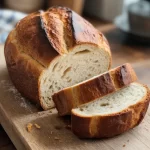
I just baked a Homemade Olive Bread that’s stupidly soft, packed with briny olives and herbs, and basically demands a smear of butter or a bowl of soup next to it.

I can’t shut up about this Homemade Olive Bread because it’s loud and salty and actually makes me eat slower. I love that crumb studded with pitted olives and that herb bite that keeps pulling you back.
It’s not precious or fussy; it’s honest, rustic, messy in the best way. I crave an Olive Bread Recipe Easy when I want bread that owns sandwiches, ruins salads in the best sense, or stands alone with a swipe of butter.
But mostly I adore tearing into it while it’s still warm and letting the olive bits do all the talking right now.
Ingredients

- Bread flour: gives structure and chewier crumb, it’s the backbone of the loaf.
- Water: hydrates dough, it helps gluten form and keeps the crumb tender.
- Active dry yeast: makes it rise, gives that light, airy lift and mild tang.
- Fine sea salt: accents flavors and controls fermentation, it’s subtle but essential.
- Sugar or honey: feeds yeast and adds a touch of sweetness, balances the olives.
- Extra virgin olive oil: keeps crumb moist and adds fruity, rich mouthfeel.
- Pitted olives: bursty, briny pockets of flavor, they’re the loaf’s savory stars.
- Fresh or dried rosemary: aromatic herb notes, it’s piney and pairs with olives.
- Freshly ground black pepper: bright, warming spice, it cuts through the richness.
- Semolina or flour for dusting: adds texture and helps with a rustic crust.
Ingredient Quantities
- 3 cups (375 g) bread flour
- 1 1/4 cups (300 ml) water
- 2 1/4 teaspoons (1 packet) active dry yeast
- 1 1/2 teaspoons fine sea salt
- 1 teaspoon sugar or honey
- 2 tablespoons extra virgin olive oil
- 1 cup (about 150 g) pitted olives, chopped (Kalamata or mixed black and green)
- 1 tablespoon fresh rosemary, chopped or 2 teaspoons dried rosemary
- 1/2 teaspoon freshly ground black pepper
- Semolina or additional flour for dusting (about 1 tablespoon)
How to Make this
1. Warm the water to about 105 to 115F (40 to 46C), stir in the sugar or honey and sprinkle the active dry yeast on top; let sit 5 to 10 minutes until foamy, if it doesn’t foam the yeast may be dead so start over.
2. In a large bowl mix the bread flour and sea salt, make a well and pour in the foamy yeast mixture and the 2 tablespoons olive oil; stir with a wooden spoon until a shaggy dough forms.
3. Turn the dough onto a lightly floured surface and knead 8 to 10 minutes until smooth and slightly tacky; you can also use a stand mixer with a dough hook for 6 to 8 minutes on medium speed.
4. Flatten the dough and sprinkle the chopped olives, chopped rosemary and freshly ground black pepper over it; fold and knead gently just until the olives and herbs are evenly distributed, try not to crush the olives too much.
5. Lightly oil a clean bowl, place the dough inside, cover with plastic wrap or a damp towel and let rise in a warm spot until doubled, about 1 to 1 1/2 hours depending on temperature.
6. Turn the risen dough out onto a lightly floured surface, gently deflate and shape into a round boule or oval batard; dust your proofing surface or a couche with about 1 tablespoon semolina or flour to prevent sticking.
7. Place the shaped loaf on the semolina dusted baking sheet or a preheated baking stone, cover loosely and let proof another 30 to 45 minutes until puffy but not overinflated.
8. Meanwhile preheat oven to 450F (230C) with a baking tray on the bottom rack for steam. Just before baking, use a sharp knife to score the top once or twice to control expansion.
9. Create steam by pouring a cup of hot water into the preheated tray or by spritzing the oven walls with water, quickly close the door and bake 20 minutes at 450F, then lower heat to 400F (200C) and bake another 10 to 15 minutes until deep golden and the loaf sounds hollow when tapped.
10. Cool the olive bread on a rack at least 30 minutes before slicing so the crumb sets; serve warm with butter or olive oil, and store in a paper bag for up to 2 days or freeze sliced for longer storage.
Equipment Needed
1. Liquid and dry measuring cups and spoons (for water, flour, yeast, salt, oil, sugar)
2. Instant read thermometer (to check 105 to 115F water)
3. Large mixing bowl (or the bowl of a stand mixer)
4. Wooden spoon or rubber spatula (for initial mixing)
5. Stand mixer with dough hook or your hands for kneading
6. Bench scraper or floured hand to help shape and handle dough
7. Baking stone or rimmed baking sheet plus a tray for creating steam in the oven
8. Sharp knife or lame for scoring the loaf, and semolina or extra flour for dusting
9. Clean kitchen towel or plastic wrap for proofing, and a cooling rack for resting the bread
FAQ
Olive Bread Recipe Substitutions and Variations
- Bread flour: swap with all-purpose flour plus 1 to 2 tablespoons vital wheat gluten to boost protein, or use 100% whole wheat flour but expect denser crumb and add an extra 2 to 4 tablespoons water.
- Water: use room temp milk or buttermilk for a richer, softer loaf; if using buttermilk reduce sugar slightly since it’s tangier.
- Active dry yeast: substitute instant (bread) yeast at a 1 to 1 ratio, or use 1 cup active sourdough starter and skip the packet but allow longer fermentation time.
- Pitted olives: swap with chopped sun dried tomatoes, roasted red peppers, or chopped capers for briny punch; if very salty rinse or reduce added salt slightly.
Pro Tips
1) Let the yeast proof on the warmer side of the range. If your kitchen is cool set the bowl over a pan of warm water or turn the oven to 200F for a minute then turn it off and proof inside. A lively, foamy yeast will save you a lot of headaches later.
2) Add the olives at the end and be gentle. Chop them coarse and fold them in with only a few kneads so they dont turn into an oily paste. If you get big pockets of olives, flatten the dough lightly and fold once more rather than overkneading.
3) Use steam for the first 12 to 15 minutes of baking to get a crisp crackly crust. A preheated pan with hot water works well, or toss a handful of ice cubes in the tray right when you close the door. Just be quick so the oven doesn’t lose too much heat.
4) Let the loaf cool at least 30 minutes before slicing. Cutting too soon makes a gummy crumb and wastes the open texture you worked for. If you need warm slices, rewarm thin slices in a toaster instead of cutting hot.

Olive Bread Recipe
I just baked a Homemade Olive Bread that's stupidly soft, packed with briny olives and herbs, and basically demands a smear of butter or a bowl of soup next to it.
8
servings
230
kcal
Equipment: 1. Liquid and dry measuring cups and spoons (for water, flour, yeast, salt, oil, sugar)
2. Instant read thermometer (to check 105 to 115F water)
3. Large mixing bowl (or the bowl of a stand mixer)
4. Wooden spoon or rubber spatula (for initial mixing)
5. Stand mixer with dough hook or your hands for kneading
6. Bench scraper or floured hand to help shape and handle dough
7. Baking stone or rimmed baking sheet plus a tray for creating steam in the oven
8. Sharp knife or lame for scoring the loaf, and semolina or extra flour for dusting
9. Clean kitchen towel or plastic wrap for proofing, and a cooling rack for resting the bread
Ingredients
-
3 cups (375 g) bread flour
-
1 1/4 cups (300 ml) water
-
2 1/4 teaspoons (1 packet) active dry yeast
-
1 1/2 teaspoons fine sea salt
-
1 teaspoon sugar or honey
-
2 tablespoons extra virgin olive oil
-
1 cup (about 150 g) pitted olives, chopped (Kalamata or mixed black and green)
-
1 tablespoon fresh rosemary, chopped or 2 teaspoons dried rosemary
-
1/2 teaspoon freshly ground black pepper
-
Semolina or additional flour for dusting (about 1 tablespoon)
Directions
- Warm the water to about 105 to 115F (40 to 46C), stir in the sugar or honey and sprinkle the active dry yeast on top; let sit 5 to 10 minutes until foamy, if it doesn’t foam the yeast may be dead so start over.
- In a large bowl mix the bread flour and sea salt, make a well and pour in the foamy yeast mixture and the 2 tablespoons olive oil; stir with a wooden spoon until a shaggy dough forms.
- Turn the dough onto a lightly floured surface and knead 8 to 10 minutes until smooth and slightly tacky; you can also use a stand mixer with a dough hook for 6 to 8 minutes on medium speed.
- Flatten the dough and sprinkle the chopped olives, chopped rosemary and freshly ground black pepper over it; fold and knead gently just until the olives and herbs are evenly distributed, try not to crush the olives too much.
- Lightly oil a clean bowl, place the dough inside, cover with plastic wrap or a damp towel and let rise in a warm spot until doubled, about 1 to 1 1/2 hours depending on temperature.
- Turn the risen dough out onto a lightly floured surface, gently deflate and shape into a round boule or oval batard; dust your proofing surface or a couche with about 1 tablespoon semolina or flour to prevent sticking.
- Place the shaped loaf on the semolina dusted baking sheet or a preheated baking stone, cover loosely and let proof another 30 to 45 minutes until puffy but not overinflated.
- Meanwhile preheat oven to 450F (230C) with a baking tray on the bottom rack for steam. Just before baking, use a sharp knife to score the top once or twice to control expansion.
- Create steam by pouring a cup of hot water into the preheated tray or by spritzing the oven walls with water, quickly close the door and bake 20 minutes at 450F, then lower heat to 400F (200C) and bake another 10 to 15 minutes until deep golden and the loaf sounds hollow when tapped.
- Cool the olive bread on a rack at least 30 minutes before slicing so the crumb sets; serve warm with butter or olive oil, and store in a paper bag for up to 2 days or freeze sliced for longer storage.
Notes
- Below you’ll find my best estimate of this recipe’s nutrition facts. Treat the numbers as a guide rather than a rule—great food should nourish both body and spirit. Figures are approximate, and the website owner assumes no liability for any inaccuracies in this recipe.
Nutrition Facts
- Serving Size: 110g
- Total number of serves: 8
- Calories: 230kcal
- Fat: 6.9g
- Saturated Fat: 1.1g
- Trans Fat: 0g
- Polyunsaturated: 0.78g
- Monounsaturated: 4.6g
- Cholesterol: 0mg
- Sodium: 750mg
- Potassium: 65mg
- Carbohydrates: 38g
- Fiber: 2.3g
- Sugar: 0.9g
- Protein: 5.1g
- Vitamin A: 0IU
- Vitamin C: 0.2mg
- Calcium: 17mg
- Iron: 1.8mg